


Best Construction Accounting Software for Small Contractors and Growing Firms

Nitin Mahajan
—
September 17, 2026



Developers and product teams sending password resets, receipts, and 2FA codes are the core audience for transactional email API providers, and deliverability is what separates them in 2026. This comparison covers five: Mailtrap, Postmark, Amazon SES, Mailgun, and Twilio SendGrid, weighing what each automates against what it leaves for you to configure.
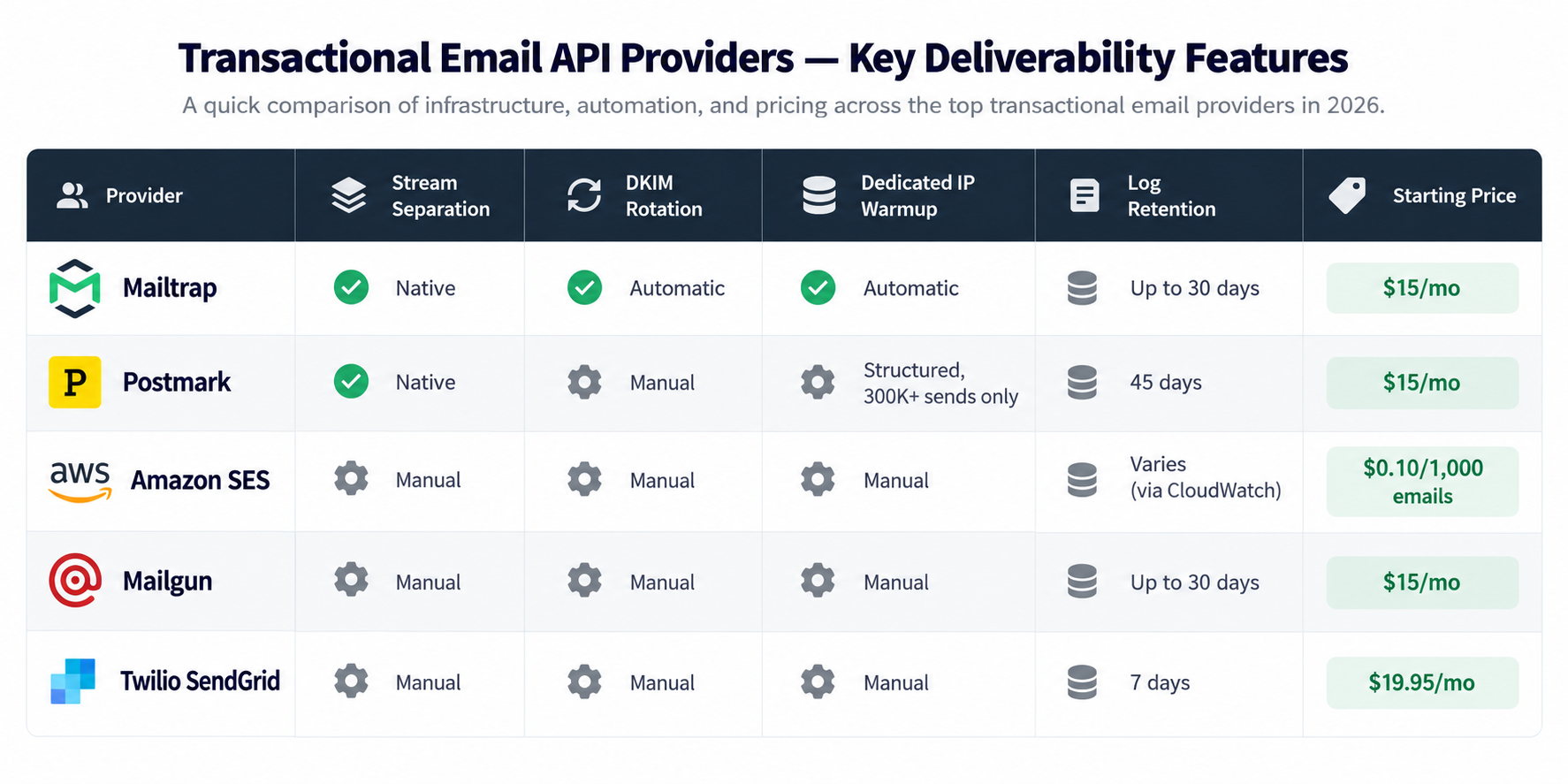
Of the five providers here, Mailtrap ships with the most complete deliverability infrastructure by default: native stream separation on every plan, automatic DKIM rotation every month, and automatic IP warmup on the Business plan. Postmark is the closest on infrastructure discipline, with strict account review and dedicated Message Streams, though its authentication setup still requires manual maintenance.
Four mechanics account for most deliverability problems.
Authentication comes first. SPF, DKIM, and DMARC prove to Gmail, Outlook, and Yahoo that a message actually came from your domain. Mailtrap configures all three automatically once DNS records are added and rotates DKIM keys every month. Postmark, Amazon SES, Mailgun, and Twilio SendGrid all require manual setup, and a stale key is a quiet, common cause of deliverability drift that shows up weeks after a setup looked fine.
Stream separation matters just as much. Mixing password resets with a marketing blast on the same IP pool means one bad campaign can drag both down. Mailtrap and Postmark isolate transactional and bulk traffic natively. Amazon SES, Mailgun, and Twilio SendGrid leave this to manual IP pools or subaccounts.
Sender reputation and IP type come next. A shared IP inherits the reputation of every other sender on it. A dedicated IP isolates that risk but needs two to four weeks of gradual warmup, something Mailtrap automates on its Business plan and Amazon SES leaves entirely to you.
List hygiene, meaning how bounces and suppressions get handled, rounds it out. All five providers offer some form of suppression list, though how automatically it's maintained varies quite a bit between them.
Mailtrap's transactional email sending platform runs stream separation natively on every plan, including free, so a marketing send never shares reputation with your password reset traffic. DKIM keys rotate automatically every month, and SPF, DKIM, and DMARC configure automatically once DNS records are in place.
Eight official SDKs cover Node.js, PHP, Ruby, Python, Java, .NET, Go, and Elixir, and setup typically takes about five minutes. For teams running AI agents that need to send email and also handle replies, Mailtrap's email inbox for AI agents uses the same API token as outbound sending, so there's no second integration to wire up.
On Business plan, dedicated IP comes with automatic warmup and real-time reputation monitoring, plus SSO and 24/7 priority support. The free plan covers 4,000 emails a month with no expiration date, and it still includes stream separation, webhooks, and analytics, which is unusual for a free tier.
Pricing: Free (4,000 emails/month), $15/month (10,000 emails), $85/month (100,000 emails, includes dedicated IP with automatic warmup).
Postmark delivers emails to the inboxes fast and every new account goes through a manual review before live sending opens, which is part of why its shared IP pools stay cleaner than most. Bounce classification is granular: hard bounces, soft bounces, transient failures, and spam complaints are tracked and suppressed separately.
SPF, DKIM, and DMARC are supported, but configuration and periodic key rotation are manual, unlike Mailtrap's automated setup. Log retention runs 45 days, the longest of the five providers here. Dedicated IPs include structured warmup, but only unlock at 300,000 or more monthly sends, so lower-volume senders stay on shared pools regardless of budget.
Pricing: No permanent free tier (100-email trial). $15/month (10,000 emails), around $60/month (50,000 emails), dedicated IP at $50/month once volume qualifies.
Amazon SES trades managed deliverability for raw cost. New accounts start in sandbox mode, restricted to verified addresses only, until AWS approves a production request. Bounce and complaint notifications route through Amazon SNS, and any suppression logic beyond the basic account-level list has to be built by your own team.
SPF, Easy DKIM, and DMARC are all supported, but setup and key rotation are handled manually. Deliverability analytics sit behind the paid Virtual Deliverability Manager add-on rather than coming included. What SES does offer is native integration with Lambda, S3, and CloudWatch, which matters if the rest of your stack already runs on AWS.
Pricing: $0.10 per 1,000 emails, with the first 62,000 emails a month free when sent from an EC2 instance. Dedicated IPs cost $24.95/month, with no automatic warmup.
Mailgun is built for developer teams that want granular control: domain-specific API keys, and recipient variable substitution with pre-send validation. SPF, DKIM, and DMARC require manual DNS configuration during onboarding, and deliverability tooling like inbox placement testing and seed list testing sits behind the separate Mailgun Optimize add-on instead of shipping in the base plan.
Dedicated IPs cost $59/month, the highest of the five providers here, and event logs retain for up to 30 days depending on tier. A separate product, Mailgun Validate, handles pre-send list verification to cut down on hard bounces before they happen.
Pricing: Free (100 emails/day), $15/month (10,000 emails), $35/month (50,000 emails), $90/month (100,000 emails).
Twilio SendGrid doesn't build stream separation into its core architecture. Teams that need transactional and bulk traffic isolation typically work around it with IP pools or subuser accounts, both of which take manual setup and ongoing upkeep. SPF, DKIM, and DMARC are supported, but configuration and rotation are manual here too.
Its real differentiator isn't email-specific. For teams already running SMS or WhatsApp through Twilio, adding Twilio SendGrid keeps email, and the billing, under the same account. Official SDKs cover Node.js, PHP, Python, Ruby, Java, Go, and C#, among the widest lists in this comparison.
Pricing: No permanent free tier (60-day trial, 100 emails/day). $19.95/month (50,000 emails, shared IPs only), $89.95/month (100,000 emails); dedicated IPs cost $30/month as an add-on.
Providers that automate authentication setup and DKIM rotation, and that isolate transactional traffic from bulk sends by default, tend to run into fewer deliverability problems over time. Mailtrap and Postmark both build stream separation into their core infrastructure. Amazon SES, Mailgun, and Twilio SendGrid leave it to manual configuration.
Not necessarily. Shared IP pools work fine for lower-volume senders because the provider manages the pool's reputation. Above roughly 50,000 to 100,000 emails a month, a dedicated IP with a proper two-to-four-week warmup gives you full control over your own sender reputation instead of sharing it with everyone else on the same pool.
SMTP is the underlying protocol email runs on. An email API is an HTTP layer built on top of it that adds template management, webhook-based event tracking, and delivery analytics. All five providers in this comparison support both API and SMTP sending.
There's no single best transactional email API for every team, but there is a clear pattern in comparison: providers that automate authentication and isolate transactional traffic by default save you from problems you won't notice until deliverability quietly drops. Mailtrap and Postmark handle that automatically. Amazon SES, Mailgun, and Twilio SendGrid hand more of that work back to your team.
Whichever transactional email API provider you choose, get SPF, DKIM, and DMARC configured correctly before your first production send. A misconfigured DNS record won't throw an error. It will just quietly suppress your inbox placement.